

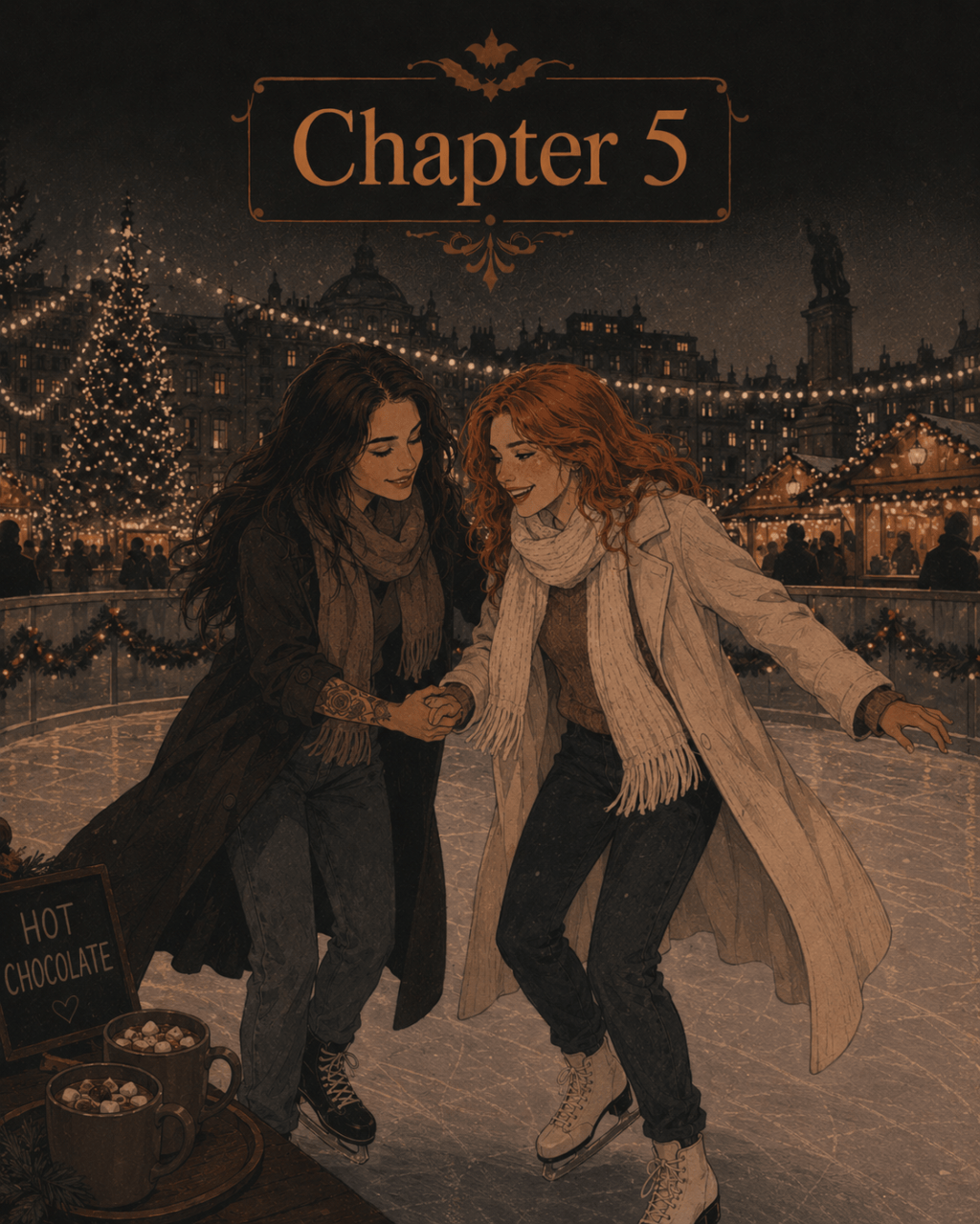
Chapter 5 – Falling, Tenderly
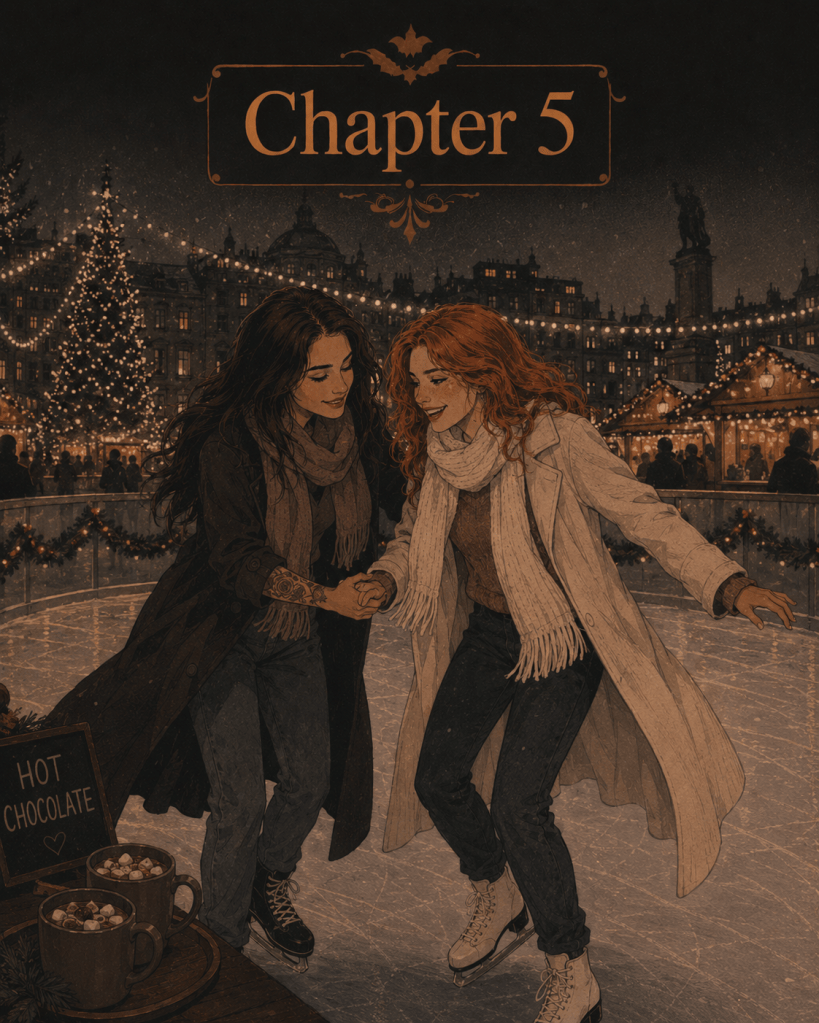
Liz arrived at the ice rink fifteen minutes early.
She had pretended it was habit, because she hated being late, because London transport was too unpredictable to be trusted. In reality, she had needed fifteen minutes to regret her decision in silence.
The rink had been set up outdoors, in the middle of a square decorated far too early for Christmas. White garlands hung between the trees; little wooden stalls sold hot chocolate, churros, hats that cost far too much, and cheerful music spun on a loop as though no one had ever suffered in the entire history of humanity.
Liz stood near the entrance, wrapped in her black coat, hands buried in her pockets.
Her coat still smelled faintly of Lelliana.
She had been ashamed of noticing.
Then she had worn it anyway.
On the ice, children shot past with outrageous confidence. Couples held hands. Teenagers laughed far too loudly every time one of them fell.
Liz eyed the white surface with suspicion.
“This is a very bad idea,” she muttered.
“Of course it is,” said a voice behind her. “That is why I had it.”
Liz turned around.
Lelliana was there.
She wore a short cream-coloured coat, a red scarf, a black skirt with thick tights, and ankle boots that were probably not suited to the cold but, naturally, looked far too good on her. Her red hair was pinned to one side with a small gold barrette. Her cheeks were pink from the wind.
She looked luminous.
Liz hated, once again, how easily that word came to her.
“You are late,” she said.
“Five minutes.”
“Eight.”
“You counted?”
“I am a librarian. Time and lateness are sacred concepts.”
Lelliana smiled.
“You look terrified.”
“I am being reasonable.”
“No. Terrified.”
“I have seen three people fall in under two minutes.”
“So the ice works.”
Liz gave her a dark look.
“Is that supposed to reassure me?”
“No. It is supposed to make me laugh.”
Lelliana laughed at her own sentence, then slipped her arm through Liz’s with a cheerful familiarity.
Liz froze.
Not much.
But enough for Lelliana to feel it.
She immediately withdrew her arm.
“Sorry.”
“No,” Liz said too quickly. “It’s all right.”
They looked at each other for a second.
Since the restaurant, there had been something more careful between them. Not less close. On the contrary. But every gesture seemed to carry a new weight now. A hand held a little too long. A glance that dropped to a mouth and rose again at once. A kind sentence regretted only because it revealed too much.
Lelliana put her hands back in her pockets.
“Shall we go in?”
“I can still run away.”
“Yes. But rule number eight: any escape before a ridiculous activity requires written justification.”
“You invent rules whenever it suits you.”
“That is the privilege of being co-founder of the unlikely friendship.”
Liz sighed.
“Fine. Let us go die.”
“With elegance.”
“With a head injury, mainly.”
They rented skates.
Liz remained seated on the bench for a long time, staring at the laces as though they belonged to some hostile technology. Beside her, Lelliana was trying to tie hers with exaggerated concentration.
“Do you know how to do this?” Liz asked.
“Absolutely not.”
“You said you didn’t know how to skate, but I assumed you were exaggerating.”
“I exaggerate often, but not when my dignity is at stake.”
She stood.
Her legs wobbled immediately.
Liz caught her by reflex.
For one second, Lelliana leaned against her, fingers clenched around her arm. They both burst out laughing at the same time.
A nervous, foolish, almost childish laugh.
“All right,” Lelliana said. “First medical observation: skates are instruments of torture.”
“I suggest we go home.”
“Rejected. We have not suffered enough yet to deserve hot chocolate.”
Liz stood in turn.
She wobbled less than Lelliana, but her expression was so concentrated that the redhead had to bite her lips to keep from laughing.
“Do not say anything,” Liz warned.
“I haven’t said anything.”
“Your face is noisy.”
“It is my brand.”
They made their way to the entrance of the ice while both clinging to the railing, with the dignity of two old ladies crossing a storm.
Liz’s first step onto the ice was a betrayal.
Her foot slid slightly sideways. She gripped the railing.
“I hate everything.”
Lelliana set one skate on the ice.
“Me too.”
Her second foot followed.
She remained perfectly still.
“There,” she said. “We are skating.”
“We are clinging to a barrier.”
“Technical detail.”
A child sped past them, overtaking them with humiliating ease.
“I hate him,” Liz said.
“He is probably six.”
“Exactly. Far too young to have that much power.”
Lelliana burst out laughing, then lost her balance. Liz tried to hold her up, but slid as well. They ended up clinging to each other, almost doubled over, laughing so hard that people started to look.
“Do not let go of me,” Lelliana breathed.
The sentence was light.
But it moved through Liz differently.
She felt Lelliana’s fingers tight around her wrist, the warmth of her body despite the cold, her breath close to her face.
“I won’t let go,” she answered.
Lelliana’s laughter softened.
Their eyes met.
For one second, the world around them blurred: the lights, the music, the children, the couples, the white scratches on the ice.
Then someone brushed past them, and they nearly fell for real.
“I take that back,” Liz said. “I may let go of you in order to survive.”
“Betrayal.”
They moved slowly along the railing.
At first, every motion was a negotiation. Then, little by little, their bodies began to understand balance. Not enough to be graceful. Just enough not to die immediately.
Lelliana fell first.
It was a slow, almost theatrical fall, during which she tried to catch hold of the air, of Liz, of her own pride, before ending up seated on the ice.
Liz stood frozen.
Then she burst out laughing.
“Rule amendment,” Lelliana said from the ground. “You are allowed to mock me only tenderly.”
“This is very tender.”
“Your face says otherwise.”
Liz held out her hand.
Lelliana took it.
Bad decision.
While trying to pull her up, Liz slid as well and landed beside her with a small, indignant cry.
For two seconds, they sat on the ice.
Then Lelliana laughed so hard she had to put a hand over her stomach.
Liz tried to remain dignified.
She failed.
The laughter rose in her, free, uncontrollable. A laugh that escaped her like something that had been locked away for a very long time. Lelliana looked at her, first surprised, then awed.
“What?” Liz asked, still breathless.
“Nothing.”
“You are looking at me strangely.”
“I had never seen you laugh like that.”
Liz lowered her eyes.
“That is because I do not often laugh like that.”
Lelliana smiled gently.
“That’s a shame.”
Liz felt her cheeks warm despite the cold.
“You are impossible.”
“Yes, but I fell with grace.”
“You fell like a wet curtain.”
“Cruel lie.”
They managed to get back up after two attempts and far too much laughing. After that, they stopped really trying to look elegant. They skated slowly, often pressed close to the railing, sometimes hand in hand to help each other keep their balance.
Officially.
Always officially.
Lelliana’s hand was warm in Liz’s.
Liz repeated to herself that it was practical. Necessary. A matter of safety.
Then she saw a couple pass in front of them: two women in their thirties, skating with ease. One held the other by the waist. They laughed softly. At one point, the taller one kissed her partner’s temple almost without slowing down.
A simple gesture.
Natural.
No one shouted. No one stopped. The world did not crack.
Liz watched them too long.
Lelliana did too.
Their hands were still joined.
Liz felt the pressure of Lelliana’s fingers change slightly. Not pull away. Not really tighten.
Just exist more clearly.
“They skate well,” Lelliana said.
Her voice was lower.
“Yes.”
“Very unfair.”
“Completely.”
They continued in silence.
But the silence was no longer only comfortable. It beat somewhere between them, charged with questions neither of them had yet found the courage to ask.
After an hour, they left the ice with mutual relief.
“My legs no longer belong to me,” Lelliana declared as she removed her skates.
“Mine have just filed a complaint.”
“We deserve hot chocolate.”
“A lot of it.”
They settled near one of the stalls, each holding a burning cup between her hands. Lelliana, of course, had taken whipped cream. Liz had pretended she did not want any, then accepted a spoonful of Lelliana’s because the redhead had looked at her as though refusal were a diplomatic offence.
Night had fully fallen. Garlands glowed above them. Passers-by crossed through a soft, almost unreal light. London seemed less hostile when it wore lights.
Lelliana’s nose was red.
Liz noticed it with a tenderness that almost made her panic.
“You’re cold,” she said.
“I am Ukrainian. The cold respects me.”
“Your nose says otherwise.”
Lelliana lifted a hand to her face.
“My nose is a traitor.”
Liz smiled.
Then her gaze was drawn to something behind Lelliana.
A shop window.
A closed shop.
In the dark glass, their reflections formed beneath the lights of the square. Liz saw herself first: her black coat, her brown hair, her cup between her hands.
Then, for an instant, the reflection trembled.
And behind her shoulder, she thought she saw Victoria.
Not clearly.
Not like in the mirror in her hallway.
Only a silhouette. Brown-haired. The same face. The same absence.
Liz stopped smiling.
The world grew cold.
Lelliana followed her gaze.
“Liz?”
Liz did not answer.
The window now showed only her own reflection, but it was too late. The feeling was there. That old emptiness. That slipping hand. That guilt that had never truly left her skin.
She set her cup down on the edge of the stall.
“I’ll be right back.”
She walked away before Lelliana could say anything.
She was not running.
She was walking fast, that was all.
Fast enough not to hear her name.
She crossed the square to a quieter, dimmer alley. There, beside a brick wall, she finally stopped. She pressed a hand to her chest, as if she could hold down what was moving inside it.
“Not now,” she whispered. “Not now.”
But grief never listened.
It had never respected good moments.
It came in precisely when she was beginning to forget it had keys.
She closed her eyes.
She saw Victoria again at twelve years old, her face identical to Liz’s except that it laughed more often. Victoria who ran faster. Victoria who spoke for her when Liz was too shy. Victoria who said: One day, we’ll go to London together. Victoria who had never been nineteen.
Liz’s throat tightened.
“You don’t have the right to come back when I laugh,” she breathed. “You don’t have the right.”
“Liz?”
Lelliana’s voice arrived carefully.
Liz quickly wiped her cheeks, angry with herself.
“I told you I was coming back.”
“Yes. You said it like someone who lies very badly.”
Lelliana stayed a few steps away.
She did not come any closer.
“You saw her?”
Liz closed her eyes.
She did not need to ask who Lelliana meant.
“In the window. Just for a second.”
“All right.”
No fear.
No judgement.
Only that word: all right.
As though what Liz had just said had a place in the world.
“I know it isn’t real,” Liz said.
“Maybe it doesn’t matter whether it is real or not.”
Liz opened her eyes.
“What do you mean?”
Lelliana looked back toward the lit square behind them.
“When I think about what happened to me, sometimes my body reacts as if it is happening now. As if the room still exists. As if the person is still there. I know it isn’t real. But that is not always enough to convince my heart.”
Liz listened in silence.
“So maybe Victoria in the mirrors is not a question of real or not real. Maybe it is your pain using your face to speak to you.”
Liz felt tears rise again.
“I miss her.”
The sentence was so simple that it felt almost violent.
Lelliana took one step closer.
“I know.”
“No. You don’t know.”
“No,” Lelliana admitted. “Not the way you do.”
Liz drew a trembling breath.
“Sometimes I am afraid of getting better.”
The confession came out before she could hold it back.
Lelliana stopped moving.
“Because if I get better,” Liz continued, “it feels as if I am leaving her even farther behind. As if the pain is the only proof that I still love her.”
Lelliana stayed silent for a long time.
Then she said:
“I don’t think love needs to hurt you in order to exist.”
Liz looked at her.
The Christmas lights behind Lelliana drew a soft halo around her red hair. She looked less bright than usual. More serious. More real.
“And if I stop hurting?” Liz asked.
“You won’t stop completely. But maybe one day you will think of her and feel something else alongside the pain.”
“What?”
Lelliana hesitated.
“Tenderness. Gratitude. Maybe even joy.”
Liz shook her head.
“I don’t know how.”
“You don’t need to know tonight.”
Lelliana held out her hand.
Not far enough to touch Liz.
Only between them.
As she had at the restaurant.
An invitation.
Liz looked at it.
Then she placed her hand in Lelliana’s.
That gesture was becoming dangerous.
Too natural.
Too necessary.
Lelliana gently closed her fingers.
“We can go home,” she said. “Or walk. Or stay here and insult shop windows.”
A wet laugh escaped Liz.
“Insult shop windows?”
“They started it.”
Liz lowered her head.
She was still crying, but less violently.
“I don’t want to go home.”
“Then we walk.”
“Not toward a bridge.”
“Never toward a bridge without official authorisation.”
They went back to the square to collect their things, then moved away from the ice rink. They walked without any particular destination, hand in hand for several streets before either of them seemed to realise it.
Neither let go.
They passed closed shops, Georgian facades, bus stops, lit windows where unknown lives went on. London was damp, cold, enormous. But Lelliana’s hand in Liz’s carved out a small habitable space.
“You know,” Lelliana said after a while, “when I was little, in Ukraine, my grandmother used to say the dead did not want us to live halfway.”
Liz turned her head toward her.
“She said that?”
“Yes. She also said a good borscht could solve three family conflicts out of five, so her theories were varied.”
Liz smiled.
“Do you miss her?”
“Yes. Very much. She stayed there when my mother and I came here. She said she was too old to start a new life in a city where even the rain had a different accent.”
“That’s beautiful.”
“She spoke like an old witch from a fairy tale. Everything sounded profound, even when she was saying a neighbour was an idiot.”
Lelliana smiled, looking ahead.
“She called me my little flame. Because I talked all the time, moved all the time, wanted shiny dresses and impossible shoes.”
“She was right.”
“Yes. But sometimes I feel as if people kept only that. The flame. Not the girl burning underneath.”
Liz gently squeezed her hand.
“I see her.”
Lelliana stopped.
So did Liz.
The sentence remained between them in the cold air.
Liz seemed to realise what she had said.
“I mean…”
“No,” Lelliana said softly.
Liz fell silent.
“Do not correct it.”
Their hands were still joined.
There was almost no one in the street. A car passed in the distance. The light of a streetlamp caught Lelliana’s face in fragments: her lashes, her mouth, the curve of her cheek.
Liz felt her gaze drop.
Just for a second.
To Lelliana’s lips.
Her heart moved so sharply that she was afraid it would show.
Lelliana saw it.
Of course she saw it.
Her expression barely changed, but her breathing became shorter.
“Elizabeth,” she murmured.
In her mouth, the name was no longer a gothic joke.
It was almost a question.
Liz did not know how to answer.
She had never kissed a woman. She had never wanted to kiss a woman. Not consciously. Not clearly. Not until that want had taken the shape of Lelliana beneath a London streetlamp, her hand in Liz’s, her cheeks pink from the cold.
She was afraid.
Not of Lelliana.
Of herself.
Of what it would mean.
Of what it would change.
“I don’t understand what is happening,” Liz said.
Lelliana looked down at their hands.
“Me neither.”
It was almost a relief.
Liz gave a nervous laugh.
“You are supposed to make a joke.”
“I know.”
“Why aren’t you?”
Lelliana lifted her eyes.
“Because I am afraid that if I joke, you will think this is nothing.”
Liz felt her breath catch.
This is nothing.
The words she had used from the beginning.
It is only a coffee.
Only a friend.
Only a hand held so we do not fall.
Only a coat.
Only a girl.
But it was no longer nothing.
It had a shape now.
Fragile, uncertain, frightening.
“I don’t want to lose you,” Liz said.
She did not know why that was the sentence that came out.
Lelliana looked touched and sad at the same time.
“You haven’t really found me yet.”
“Yes, I have.”
The answer was immediate.
Too sincere.
Lelliana went still.
Panic filled Liz’s eyes.
“Sorry. I didn’t mean…”
“Yes,” Lelliana said. “You did.”
Liz did not protest.
Because it was true.
Lelliana moved very slightly closer.
Not enough to kiss her.
Enough for the world to tighten.
“I think I found you too,” she said.
Liz closed her eyes for a second.
She felt the cold on her cheeks, Lelliana’s hand, the distant noise of London, the weight of Victoria somewhere behind her, less crushing than usual. As if her sister were not pulling her backwards that night. As if she were simply standing in a room of the past, letting Liz look toward the door.
When Liz opened her eyes again, Lelliana was still watching her.
They could have kissed.
The desire was there.
Clear.
Terrifying.
But Lelliana gently stepped back half a pace.
Liz felt an immediate, shameful disappointment.
“Sorry,” Lelliana said.
“Why?”
“I don’t want us to do this because we are upset.”
Liz looked at their hands.
“You’re right.”
She hated, a little, that Lelliana was right.
Lelliana gave her a small, sad smile.
“I want, if it happens, for you to be sure it is me you want to kiss. Not just someone who held you while you cried.”
Liz looked up sharply.
“That is not what this is.”
“I know.”
“No, you don’t know.”
Lelliana looked at her, startled by the intensity in her voice.
Liz felt her face burn.
“It is not just because you were there when I was not all right. It is not just because you listen to me, or because you are kind to me. I look at you even when you are doing nothing. I think about what you are going to answer before I have even written to you. I kept a paper napkin as if it were a precious document. I wear my own coat like an idiot because it smelled like you for three days.”
She stopped, horrified by everything she had just said.
Lelliana stared at her.
Silent.
Liz wanted to disappear.
“I am going to throw myself under a bus,” she muttered.
Lelliana burst out laughing.
Not a mocking laugh.
A surprised laugh, moved, almost relieved.
“Do not do that. I have only just got an interesting ally back.”
“I am seriously humiliated.”
“No. You are…”
Lelliana searched for the word.
Her smile softened.
“You are very brave.”
Liz shook her head.
“I am terrified.”
“Often, that is the same thing.”
The sentence stayed there.
They looked at each other again.
Then Lelliana, very slowly, lifted Liz’s hand to her lips.
She did not kiss her mouth.
Only her fingers.
A light, almost invisible kiss placed on her cold knuckles.
Liz stopped breathing.
The gesture was tender.
Chaste.
More devastating than a stolen kiss.
“There,” Lelliana said softly. “That, I think, we can keep for tonight.”
Liz looked at her hand as though it no longer quite belonged to her.
“All right.”
Her voice was barely audible.
Lelliana smiled.
“You are bright red.”
“Shut up.”
“It is adorable.”
“Rule number I-have-lost-count: no commenting on an ally’s blushes.”
“Rejected. Too precious.”
Liz tried to give her a severe look.
She failed.
They began walking again.
This time, their fingers interlaced differently.
Less out of necessity.
More by choice.
They barely spoke until they reached Lelliana’s bus stop. When they got there, the sign announced a six-minute wait.
Six minutes was little.
Far too much.
Lelliana leaned against the shelter, eyes lifted toward Liz.
“So,” she said. “We survived the ice rink.”
“Barely.”
“We insulted a shop window.”
“Mentally.”
“We almost had a very serious conversation under a streetlamp.”
“Almost?”
“I am sparing you.”
Liz smiled.
Then she asked:
“What are we doing?”
Lelliana breathed in slowly.
“I don’t know.”
“That is reassuring.”
“But I know I do not want to stop.”
Liz felt something open in her chest.
Fear.
And behind it, a tiny joy.
“Me neither.”
Lelliana lowered her eyes, smiling.
“Then we continue. Slowly.”
“Slowly.”
“With rules.”
“Many rules.”
“And hot chocolate.”
“Obviously.”
The bus appeared at the end of the street.
Liz felt an absurd frustration.
She wanted more time.
Another street.
A few more minutes.
One more chance not to go home alone with all her questions.
The bus stopped.
The doors opened.
Lelliana stepped up once, then turned around as she always did.
But this time, she did not immediately make a joke.
She looked at Liz with a tenderness that disarmed everything.
“Good night, Elizabeth.”
Liz closed her fingers around the hand Lelliana had kissed earlier.
“Good night, Lelliana.”
The redhead smiled.
Then, just before the doors closed, she added:
“And for the record, your coat suits you better when it smells a little like me.”
Liz opened her mouth, scandalised.
Too late.
The doors closed.
Lelliana gave her a small wave from behind the glass.
Liz remained alone on the pavement, red, shaken, alive.
When she got home, she stopped in front of the hallway mirror.
As always.
Her reflection looked back at her.
For a second, she thought Victoria might appear.
She waited.
Nothing.
Only her.
Liz slowly lifted the hand Lelliana had kissed and touched the mirror with the tips of her fingers.
“I think I am falling in love,” she whispered.
The silence did not break.
But this time, it did not feel like an absence.
It felt like a soft answer, coming from very far away.
Her phone vibrated.
Lelliana: I am home. My legs hate me, but my heart seems strangely optimistic. This is worrying.
Liz read the message several times.
Then she replied:
Liz: Mine too.
She pressed the phone against her chest.
And, for the first time, she did not try to give what she felt another name.


Leave a comment