

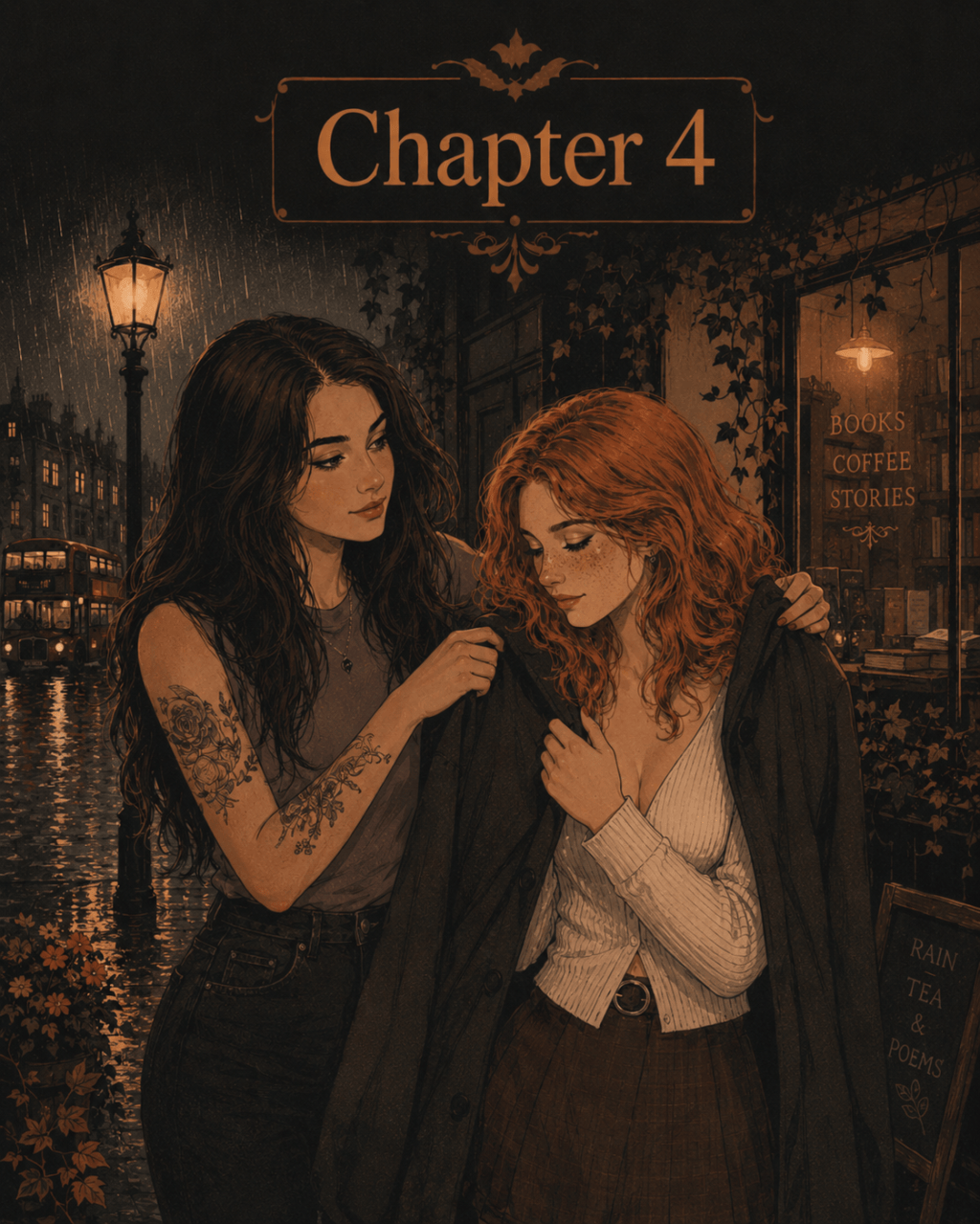
Chapter 4 – Liz’s Coat
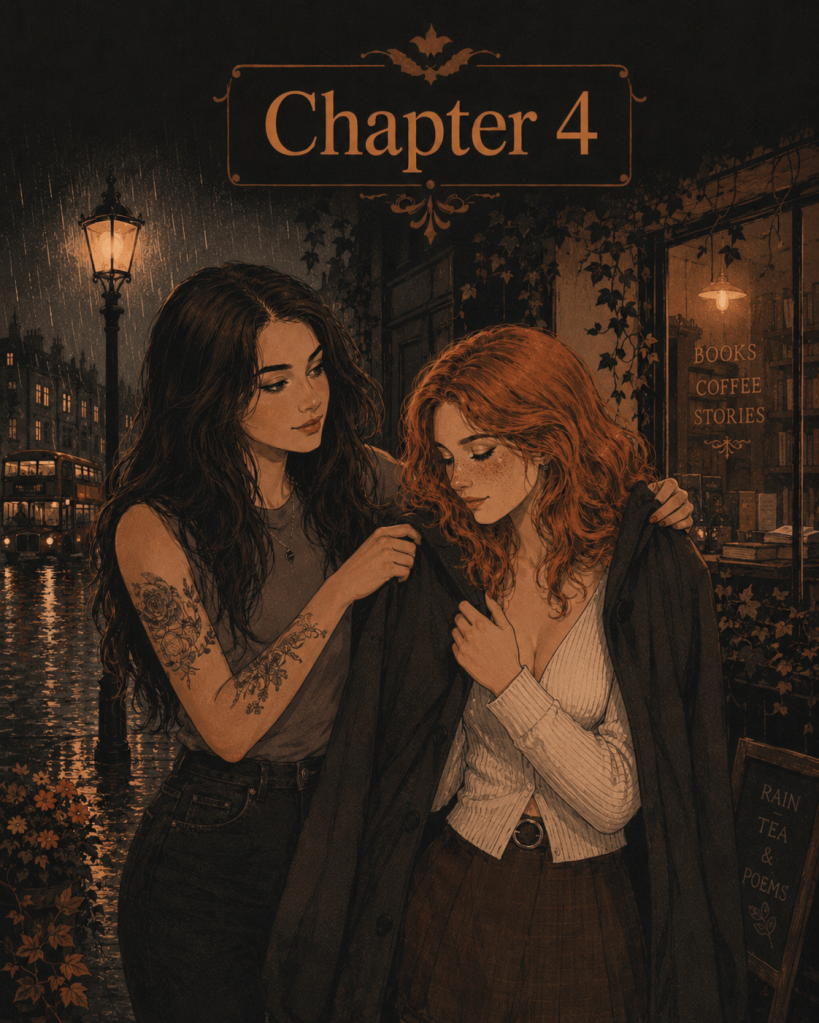
Lelliana kept the coat for three days.
Officially, because she was working too much to return it.
Officially, because between two shifts, two nights that were far too short, and three late buses, it had been impossible to find a proper moment to stop by the library.
Officially, because she had forgotten.
That was a lie.
She had not forgotten anything.
Liz’s coat hung over the chair in her bedroom, in her small flat in Southwark. It was black, a little too long for Lelliana, plain, soft to the touch, and it carried that discreet scent of old paper, cold rain, and black tea.
A calm scent.
A scent that asked for nothing.
The first evening, she had put it there without thinking.
The second, she had brushed her fingers over it as she passed.
The third, she caught herself wearing it in her living room, over her pyjamas, at two in the morning, a mug of herbal tea between her hands.
“This is pathetic,” she murmured to herself.
The coat did not answer.
It was very good at that.
Lelliana sat down on the sofa, legs tucked under her. The television was on with the sound muted. Blue, useless images moved across the walls of the flat. Outside, London breathed in the dark: a bus passing, a distant siren, footsteps on the wet pavement.
She had had a long day.
Too long.
At the hospital, a woman had cried after receiving bad news. An elderly man had held her hand and called her by his daughter’s name. A junior doctor had made a heavy joke about her skirt, as though a caregiver’s uniform did not already carry enough idiotic fantasies in men’s heads. And Clara, whom she had run into by chance near the cafeteria, had given her a polite smile.
An apology smile without an apology.
Lelliana had answered with a theatrical grimace and said, “Do not worry. I am almost always offended. It saves me having to choose my battles.”
Clara had laughed.
Everyone had laughed.
Lelliana too.
Then she had gone home, closed her door, and the laughter had left her face like make-up wiped away too harshly.
She picked up her phone.
No message from Liz since the morning.
It did not matter.
Obviously it did not matter.
Liz was working. Liz had a life. Liz was not meant to fill Lelliana’s silences the second they became too loud.
Still, she opened their conversation.
Liz: Do not forget to eat something that did not come from a vending machine.
Lelliana read the message again.
Then she replied:
Lelliana: Too late. The vending machine and I are in a stable relationship.
The answer came five minutes later.
Liz: I disapprove of this union.
Lelliana smiled.
That little smile, no one ever saw it.
It was not made to seduce, to provoke, to defend herself.
It was simply there.
Lelliana: You are jealous because you do not have a vending machine in your library.
Liz: We have lost readers, damaged novels, and Margaret. That is already a lot.
Lelliana: Margaret frightens me and I have not even met her.
Liz: Wise instinct.
Lelliana pressed the phone against her chest.
She wanted to tell her: your coat makes me feel safe.
But that was too much.
Too intimate.
Too strange.
So she wrote:
Lelliana: I will return your coat tomorrow. Before I get attached to it and we run away to start a new life in Scotland.
Liz: I always knew it was unfaithful.
Lelliana: It has good taste.
This time, Liz took longer to answer.
Lelliana watched the screen with a ridiculous amount of attention.
Then:
Liz: Tomorrow after I close?
Lelliana’s heart made a small, stupid movement.
Lelliana: All right. Six?
Liz: Six.
Lelliana set the phone down.
She looked at the coat on her shoulders.
“You hear that?” she said to the fabric. “Tomorrow, you go back to your rightful owner.”
Then, after a silence:
“Do not judge me. I am very tired.”
The next day, the hospital seemed determined to test her patience.
At seven, an alarm went off in the wrong ward. At nine, a patient refused her IV while calling everyone administrative vampires. At eleven, a child vomited on the shoes of a doctor who perhaps deserved the experience a little. By noon, Lelliana still had not had her coffee.
“Are you still smiling?” Nadia asked, a healthcare assistant she got on well with.
“I am Ukrainian,” Lelliana replied, checking a file. “We survive out of pride.”
“No, you survive out of sarcasm.”
“That too. It is medicinal.”
Nadia handed her a paper cup of coffee.
“Here. Before you bite someone.”
Lelliana took the cup with gratitude.
“I would marry you if I still believed in marriage.”
“I am already taken, beautiful.”
“National tragedy.”
Nadia laughed, then her gaze fell on the black coat folded over a chair in the break room.
“Is that yours?”
Lelliana followed her eyes.
“No.”
“Ah.”
That ah was far too loaded.
“Do not make that face,” Lelliana said.
“What face?”
“The face of someone about to ask me an unbearable question.”
Nadia sat down across from her.
“Whose is it?”
“A friend’s.”
“A friend?”
“Yes, Nadia, the concept exists. Two people can speak to each other without reproducing in the toilets of a bar.”
Nadia raised both hands.
“I did not say anything.”
“Your face did.”
“My face is very talkative, that is true.”
Lelliana drank her coffee. Too hot. Too bitter.
“Her name is Liz,” she added despite herself.
Nadia smiled.
“Ah.”
“Say ah like that again and I will attack you with a stapler.”
“You said her name very softly.”
“I did not.”
“You did.”
“You are lying.”
“I have been caring for people for fifteen years. I know how to recognise a woman saying a name as if she were holding a burning cup.”
Lelliana wanted to joke.
As always.
A brilliant sentence, a provocation, a wink.
Nothing came.
She looked at the coffee in her hands.
“It is not what you think.”
Nadia’s expression softened.
“I am not thinking anything.”
“She is… different.”
“Different how?”
Lelliana thought of Liz in the rain, unable to look at the bridge. Of her cold hand held in hers. Of her voice when she had said, I can stay beside you.
She thought, too, of the bookshop, of the napkin folded with the rules of their alliance, of the way Liz sometimes looked at her as if she were trying to read beneath her skin without tearing the pages.
“She does not look at me the way other people do,” she said at last.
Nadia did not answer immediately.
Then:
“That must feel good.”
Lelliana swallowed with difficulty.
“Yes.”
The word was small.
Almost dangerous.
Because it opened a door.
And Lelliana knew what happened when doors opened.
Someone always ended up coming in.
The day went on.
At four, a man in his forties, brought in for a hand injury after a fight, began staring at her a little too long while she prepared the supplies.
“Pretty trainee nurse,” he said with a thick smile.
Lelliana kept her professional face in place.
“Place your hand on the sterile field, please.”
“You have an accent.”
“You have a bleeding wound.”
“Is it Russian?”
Her fingers tightened slightly around the gauze.
“Ukrainian.”
“Ah. Eastern girls…”
He did not finish the sentence.
He did not need to.
Lelliana felt her body close.
Not visibly. She was very good at showing nothing. Her smile stayed in place, thin and controlled. Her gestures remained precise.
But inside, something retreated.
Very far.
Very fast.
A memory without a clear image. A smell. A weight. A voice too close. Hands. The ceiling of a room she had tried to stare at so she would not be in her body anymore.
She breathed in through her nose.
Not here.
Not now.
She set the gauze down with perfect calm.
“I am going to ask a colleague to finish with you.”
“Oh, are you offended?”
She looked up at him.
Her smile vanished.
“No. I am professional. And my profession includes not wasting my time on idiots.”
She left before he could answer.
In the corridor, she walked quickly to the supply room, went inside, and closed the door behind her.
Only then did her hands begin to shake.
She hated it.
She hated that her body remembered better than she did. She hated sentences that opened trapdoors beneath her feet. She hated being nineteen and sometimes still feeling trapped inside a night she could not manage to end.
She leaned against a metal shelf.
Breathe.
As she had told Liz.
Not deeply. Just a little.
Her fingers found her phone before she had truly decided to reach for it.
She opened their conversation.
She did not want to write.
She did not want to be that girl.
Fragile.
Broken.
Dramatic.
So she typed:
Lelliana: Important information: I have just officially discovered that I hate men who think they are charming.
She nearly deleted it.
Then she sent it.
Liz’s answer arrived less than a minute later.
Liz: That is a very healthy moral position.
Lelliana gave a trembling laugh.
Lelliana: I am in a supply room with gauze pads. Glamorous moment.
This time, Liz did not answer straight away.
Then:
Liz: Do you want me to distract you, or stay serious?
Lelliana stared at the words.
It was exactly the right question.
She did not know how Liz did that.
Lelliana: Distract me.
Liz: Margaret has just threatened a teenager because he dog-eared a page. I think she could run a prison.
Lelliana: I already love her.
Liz: She would find you too loud.
Lelliana: Everyone finds me too loud.
Liz: Not me.
Lelliana stopped breathing for one second.
Three words.
Ridiculous.
Simple.
Not me.
She reread the message.
Then again.
Something inside her, something that had been tense all day, eased by the smallest degree. Not enough to cry. Enough not to fall.
She replied:
Lelliana: Lie. I am objectively unbearable.
Liz: Objectively, yes. But not too loud.
Lelliana smiled, her eyes wet.
“Idiot,” she murmured.
She did not know whether she meant Liz or herself.
At twenty past six, Lelliana arrived outside the library, twenty minutes late, the coat folded in her arms.
The front of the building was lit by streetlamps. Through the tall windows, she could see the shelves, the tables, the rare silhouettes of the last readers. It was a quiet place, almost outside time.
Lelliana stood outside for a moment.
She had reapplied her lipstick in the hospital toilets. She had fixed her hair. She wore a short dress under her own coat, like a familiar suit of armour. She looked like the girl everyone recognised.
She hoped Liz would not see the rest.
Then the door opened.
Liz appeared.
Long dark coat, brown hair loose, pale face under the soft light of the entrance. She looked tired too, but with a quieter kind of tiredness, less visible.
Her gaze landed at once on Lelliana.
Not on her dress.
Not on her legs.
Not on her mouth.
On her face.
Of course.
“You are late,” Liz said.
“I am a very sought-after woman.”
“By A&E?”
“By chaos in general.”
Liz came down the steps.
“Are you all right?”
Lelliana lifted the coat between them.
“I have brought back your hostage.”
Liz took it, but did not move right away.
“Lelliana.”
The redhead hated the softness of her name.
She hated, most of all, how badly she needed it.
“I am fine,” she said.
Liz did not answer.
She only looked at her.
Rule number three.
We do not force questions.
But Liz did not have to force anything. Sometimes, her presence alone was enough to make lies heavier to carry.
Lelliana sighed.
“I am not very fine. But I do not want to talk about it.”
Liz nodded slowly.
“All right.”
And that was all.
No why.
No what happened?
No wounded look because she had not been given access.
Lelliana felt a wave of gratitude tighten her throat.
“Are you hungry?” Liz asked.
“Always.”
“There is a place nearby. They make decent soup.”
“Soup? You really know how to sell a dream, Elizabeth.”
“It is cold.”
“I am sexy, not reasonable.”
“Exactly.”
Lelliana smiled.
“Are you trying to keep me alive?”
“Against your will, yes.”
They walked together down the street.
The night was clear and cold. Shop windows were already preparing for Christmas too early, with pale garlands and fake snow. Passers-by brushed past without seeing them. Liz carried her coat over her arm, as if she did not want to put it on while it still kept Lelliana’s warmth.
Or perhaps Lelliana was inventing that.
She had been inventing a great many things lately.
The little restaurant was almost empty. Wooden tables, low lamps, the smell of warm bread. Liz chose a table in a corner. Lelliana sat opposite her.
“You always choose corners,” she noticed.
“Yes.”
“So you can see danger coming?”
Liz lifted one shoulder.
“So it is not behind me.”
The answer was simple.
Too simple to be light.
Lelliana nodded.
“I understand.”
Liz looked at her.
“Yes,” she said softly. “I think you do.”
They ordered two soups, bread, and then tea. For a few minutes, they talked about things that did not matter: a reader who had confused Jane Austen with Agatha Christie, a patient who had treated her cast like a fashion accessory, a cat spotted in a shop window.
Lelliana found a little of her lightness again.
Not all of it.
But enough to breathe.
Then Liz placed her coat on the empty chair beside her.
“It smells different,” she said.
Lelliana stiffened.
“Different how?”
“The perfume. Yours.”
“Sorry.”
“I did not say it was bad.”
Lelliana looked down at her cup.
“Ah.”
The silence became very present.
Liz seemed to realise it. She stirred her tea without drinking.
“Thank you for keeping it.”
“I should be thanking you. It saved me from hypothermia and two existential crises.”
“Only two?”
“The week is not over.”
Liz smiled.
Lelliana looked at that smile, and her heart made that absurd, increasingly frequent reaction, like missing a step on a staircase.
She thought: This is not normal.
Then: What does normal even mean?
She had liked boys.
Or she had tried to.
Sometimes, she had wanted to be desired more than she had wanted the person in front of her. Sometimes, she had searched in a man’s arms for proof that she still possessed her body. Sometimes, she had confused attention with tenderness, being looked at with respect, night with comfort.
She had never looked at a woman the way she looked at Liz.
And it terrified her less than she would have expected.
It terrified her differently.
Because with Liz, she did not know how to play.
She did not know which smile to use, which line to throw out, which posture to adopt in order to keep control. Liz saw the cracks too quickly and, worse, did not seem to want to use them.
“You went far away,” Liz said.
Lelliana blinked.
“Sorry?”
“You looked elsewhere.”
“I was thinking.”
“Dangerous.”
“Very. I should stop before I discover a personality.”
Liz gave a small laugh.
Then, after a silence:
“I wanted to thank you too. For the other night. The bridge.”
Lelliana put down her spoon.
“You do not have to thank me.”
“I do.”
“No.”
“Lelliana.”
The name, again.
It went through her.
Liz continued more softly:
“You asked before you took my hand.”
Lelliana stayed still.
“Of course.”
“Not everyone does.”
There was a sentence there heavier than the moment.
Lelliana heard it.
She felt something answer inside her, like one pain recognising another pain in the dark.
“No,” she said. “Not everyone does.”
They looked at each other.
The restaurant around them seemed to draw away.
Lelliana felt the question in Liz’s eyes.
Not spoken.
Not forced.
Only present, like a hand held out at a distance.
She could have chosen not to answer.
She could have smiled, made a joke, talked about her tea being too hot.
But perhaps the coat had kept Liz’s scent too long. Perhaps the day had been too hard. Perhaps she was tired of shining beneath the wrong eyes.
“A few years ago,” she said, “someone did not ask me.”
Liz did not move.
Not even to show her pain.
She stayed there, attentive and silent.
Lelliana stared at the table.
“I do not want to tell the details.”
“You do not have to.”
The answer came so quickly that Lelliana had to close her eyes.
She had thought that by saying it she would set off something huge, dramatic, uncomfortable. Pity. Horror. Clumsy curiosity.
But Liz took nothing from her.
She only kept the space open.
“Afterwards,” Lelliana went on, “I thought that if I chose a lot, then what had happened would matter less. That if I said yes often, very often, then the no that had been stolen from me would become smaller.”
Her voice was low.
Almost calm.
That calm frightened her.
“People saw the result. Not the reason. It is easier to say I am easy than to wonder why I needed people to look at me as if I were still alive.”
Liz’s eyes were bright.
But she was not crying.
She did not allow herself to take over the space with her own emotion.
“You were alive,” she said.
Lelliana looked up.
Liz had spoken softly, but with an almost fierce certainty.
“You still are.”
Lelliana gave a sad smile.
“Some days, yes.”
“On the other days, you can borrow a coat.”
It was awkward.
Simple.
Perfect.
Lelliana laughed, and the laugh broke a little in the middle.
She pressed a hand to her mouth.
“Sorry.”
“Do not apologise.”
“Habit.”
“Then unlearn it.”
Lelliana looked at her.
“Giving orders now, are we?”
“I provide literary and moral recommendations.”
“How arrogant.”
“I am highly qualified.”
The silence returned, softer.
Lelliana felt that she had given something she could not take back. A truth placed between them, fragile but whole. She expected to feel naked, exposed, ridiculous.
Instead, she felt tired.
And a little lighter.
Liz was looking at her cup. Her fingers were tight around the porcelain.
“Victoria died because I let go of her hand,” she said suddenly.
Lelliana breathed in slowly.
“You were twelve.”
“That does not change anything.”
“It does.”
“No.”
Liz closed her eyes.
“Everyone has told me that. That I was a child. That I could not have held her. That it was not my fault. But my body does not believe them. My body remembers her fingers slipping. It remembers that I screamed too late.”
Lelliana felt her own eyes fill with tears.
“Liz…”
“I am angry at her because she left me with her face. And I am angry at myself because part of me resents her for it. What kind of sister does that?”
The question remained suspended.
Cruel.
Human.
Lelliana had no great answer. No perfect sentence that could repair seven years of grief, mirrors, and guilt.
So she did what Liz had done for her.
She did not force anything.
She stayed.
“A sister who is hurting,” she said. “Not a bad sister. Just a sister who is hurting.”
Liz’s face cracked.
A tear fell down her cheek.
Lelliana felt her own reflex: make a joke, lighten it, run.
She did not.
She slowly reached across the table, palm open.
An invitation.
Not a demand.
Liz looked at that hand.
Then she placed hers in it.
The contact was simple.
Warm.
Less panicked than it had been on the pavement the other night.
More chosen.
Lelliana’s thumb almost brushed Liz’s fingers, then stopped, as if still asking permission. Liz gently squeezed her hand.
Neither of them spoke for a while.
In the restaurant, someone laughed near the counter. A coffee machine hissed. Outside, a bus passed with a heavy rumble.
The world went on.
But at that table, something had stopped long enough to be looked at.
When they left the restaurant, it was late.
Liz insisted on walking Lelliana to her bus.
“I am the one who should return your coat,” Lelliana said.
“You already did.”
“Then why are you still carrying it over your arm?”
Liz looked down, as if she had only just noticed.
“It still smells like your perfume.”
She seemed to regret the words immediately.
Lelliana stopped.
Her heart beat too hard.
Liz flushed slightly.
“Forget it.”
“No.”
The word came out faster than expected.
Liz looked at her.
Lelliana could have smiled. She could have turned it into a joke.
She did not.
“Do not ask me to forget kind things,” she said.
Liz stayed silent.
The street was almost empty. The light of a streetlamp fell over them, golden and fragile. The wind lifted a few brown strands around Liz’s face.
Lelliana suddenly wanted to touch her.
Just tuck one strand behind her ear.
A tiny gesture.
Impossible.
She kept her hands in the pockets of her jacket.
“All right,” Liz said.
The bus approached in the distance.
As always, it came too soon.
As always, it forced them to choose an ending for the evening.
Lelliana climbed onto the first step, then turned back.
“Elizabeth?”
“Yes?”
“Next time, I am inviting you.”
“For soup?”
“Do not be insolent. For something better than soup.”
“Difficult.”
“Ice skating.”
Liz blinked.
“I do not know how to skate.”
Lelliana’s smile returned, a little brighter.
“Neither do I.”
“Then why?”
“Because falling will be less humiliating if there are two of us.”
Liz looked at her.
Then she smiled.
That smile, Lelliana wanted to keep in an inside pocket, close to her heart.
“All right,” Liz said.
The bus doors opened.
Lelliana got on.
Before the doors closed, Liz lifted the coat slightly.
“I might not wash it right away.”
Lelliana felt heat rise to her face.
“I am going to pretend that is normal.”
“Good night, Lelliana.”
“Good night, Elizabeth.”
The bus pulled away.
Lelliana sat by the window. She watched Liz grow smaller on the pavement, a dark silhouette beneath the light, until she disappeared behind the mist on the glass.
She rested her head against the cold window.
Her phone vibrated a few minutes later.
Liz: New rule: no mocking people who fall at the ice rink.
Lelliana smiled.
She replied:
Lelliana: Rejected. We can mock, but only with tenderness.
Liz’s answer came almost at once.
Liz: Amendment accepted.
Lelliana put her phone away.
She looked at her reflection in the bus window. Red hair, lipstick a little faded, tired eyes. She looked like herself.
For once, that did not seem entirely unbearable.
At home later, she removed her make-up slowly. She took off her jewellery, set her shoes beside the bed, and pulled on an old jumper that was much too big.
Without Liz’s coat, her flat seemed colder at first.
Then she remembered the hand on the table.
The way Liz had listened.
The sentence: You were alive. You still are.
Lelliana switched off the light and slid under the covers.
She did not fall asleep right away.
She thought about the ice rink.
About Liz not knowing how to skate.
About their hands perhaps having to hold each other again, officially so they would not fall.
She smiled in the dark.
“Unlikely friendship,” she murmured.
The words sounded less and less sufficient.
But, for now, they allowed them to move forward.
So she kept them.


Leave a comment