

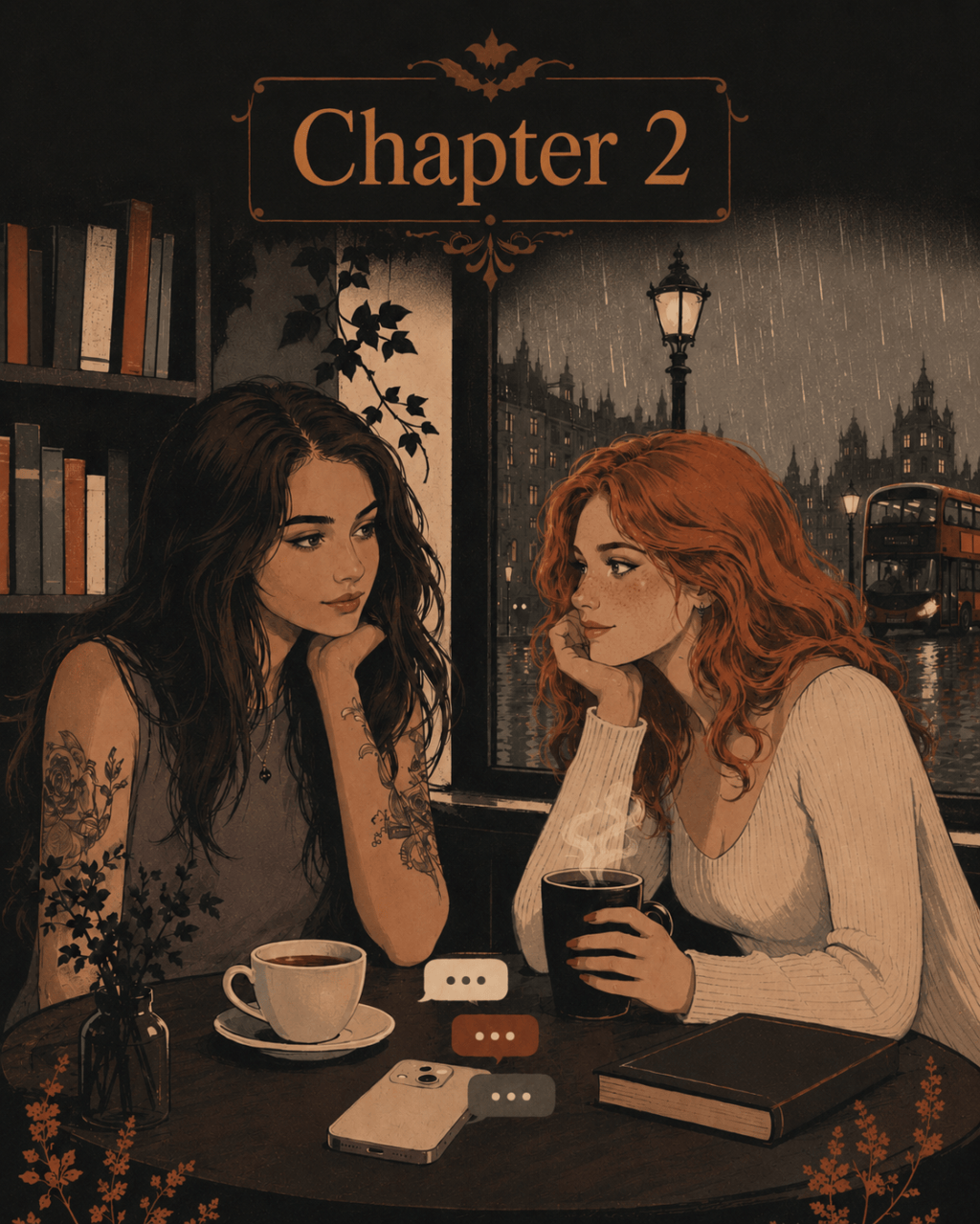
Chapter 2 – The Messages We Don’t Delete
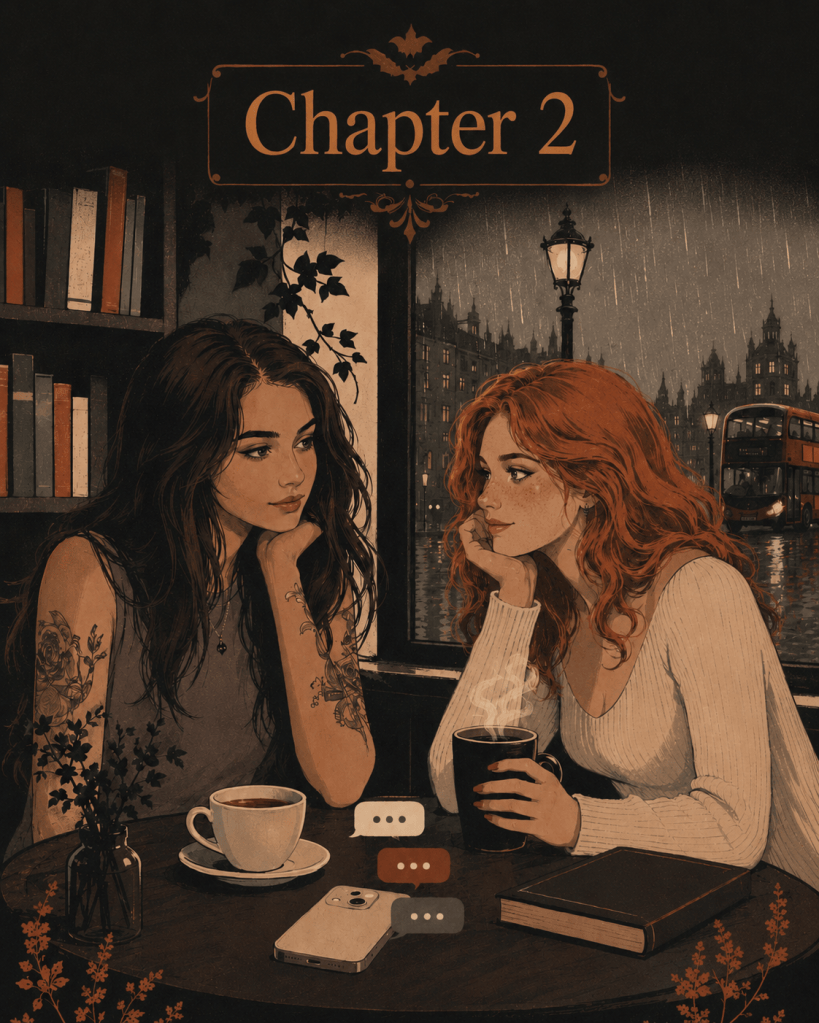
The day after Halloween, London had the particular kind of hangover only big cities know how to wear.
The pavements were littered with crushed cups, wet glitter, and plastic vampire teeth abandoned near the gutters. Shop windows reflected a low, thick, grey sky, as though the previous night had never quite ended. On the Underground, Liz passed a witch without her hat, a zombie with half his make-up gone, and a man in a cape asleep against the window with almost royal dignity.
She should have thought the evening was over.
She should have tucked it away in a corner of her memory with all the other survivable social events: uncomfortable, loud, pointless, but past.
Except that at 8:17, her phone vibrated.
Liz was behind the counter at the library, sliding registration cards back into a drawer. She glanced down at the screen.
Lelliana: Official morning-after-Halloween report: I am alive, but my mascara has seen hell.
Liz stared at the message.
Then she smiled.
A brief smile, discreet, almost involuntary.
She looked around, as if someone might catch her doing something wrong. The library was still nearly empty. Only an old man was reading the newspaper by the window, and a student was already asleep on her laptop.
Liz picked up her phone again.
She wrote:
Liz: Condolences to the mascara. It looked brave.
She hesitated before sending it.
It was stupid.
Too light.
Too familiar.
She sent it anyway.
The reply came almost at once.
Lelliana: Thank you. The ceremony will be held in my bathroom. Black clothing required.
Liz bit the inside of her cheek to keep from laughing.
“Good night?” a voice asked.
Liz almost jumped.
Margaret, her colleague, a woman in her fifties with red glasses and eyes far too observant, had appeared behind her with a stack of returned books.
“Sorry?”
“Halloween. You went out, didn’t you? Noah told me you were going to a party.”
Liz put her phone away a little too quickly.
“It was… bearable.”
Margaret arched an eyebrow.
“From you, that is almost enthusiasm.”
“Do not get carried away.”
“Did you meet someone?”
Liz felt heat climb up her neck.
“No.”
The word came out too sharply.
Margaret smiled.
“All right. So yes.”
“I met several people. It was a party. The concept generally involves several people.”
“Of course.”
Margaret placed the books on the counter and walked away without pressing. That was what Liz liked about her. She saw far too much, but she did not force doors open.
Liz went back to work.
For two hours, she shelved novels, helped a teenage girl find a book of poetry, explained for the third time that week to a man in a hurry that no, the library did not sell pens, and tried not to look at her phone every five minutes.
She failed.
Lelliana: Serious question. If I read Shirley Jackson on the bus, do I become officially interesting or just pretentious?
Liz answered while hiding behind a shelf.
Liz: Depends. Are you holding the book to read it or to impress passers-by?
Lelliana: Both. I multitask.
Liz: Then pretentious, but with potential.
Lelliana: I’ll take it.
Liz slipped the phone against her chest, unsettled by how easy the exchange felt.
With other people, she thought too much. Every message was a small trial: too cold, too long, too direct, not funny enough. With Lelliana, the words came faster. As though they were less afraid.
Which was precisely the problem.
At noon, the library emptied almost completely. Rain began to fall against the tall windows, thin and regular.
Liz used the quiet to go upstairs to the old storage room, where the most fragile books were kept.
It was her favourite room.
It smelled of dust, yellowed paper, and polished wood. Light entered timidly through the high windows. A large antique mirror, slightly speckled, had been leaning against the wall for years. No one really knew why it was there. Perhaps it had once belonged to the building. Perhaps someone had simply forgotten to throw it away.
Liz often avoided looking at it.
Today, however, she stopped in front of it.
Her reflection gave her back her silence.
A young brunette woman in a simple black dress, her hair loose, her face too pale after a short night.
Then, for a second, she imagined Victoria beside her.
Not really an apparition. Not like in bad films. More a sensation. An absence taking shape.
Victoria would have laughed at her.
She would have snatched her phone, read the messages over her shoulder, and sung something unbearably annoying.
Liz has a friend. Liz has a pretty friend.
“Shut up,” Liz whispered.
Silence answered.
Her heart tightened.
There were days when Victoria’s death was an old event. A tragedy made almost neat by being told in the same words over and over: my sister died when we were twelve. People would then put on a sorrowful expression, set a clumsy hand on her arm, and change the subject.
And then there were the other days.
The days when Victoria had not died seven years ago.
The days when she had just fallen.
The days when Liz still felt that if she reached out fast enough, hard enough, she might catch her.
Her phone vibrated.
Liz looked down.
Lelliana: What time do you finish today, dangerous librarian lady?
Liz stared at the message.
She should have answered simply.
Six.
Then put the phone down.
Returned to her life.
Instead, she wrote:
Liz: Why? Are you planning a literary hostage situation?
Lelliana: Maybe. Or coffee. Much less illegal.
Liz felt something stir inside her.
A desire.
Simple, absurd, terrifying.
To see Lelliana.
Not by accident at a party. Not under the excuse of a mutual friend. To see her because they had decided to.
She looked at the mirror again. Her reflection seemed to be waiting for her answer.
So she typed:
Liz: I finish at six. There is a cafe opposite the library.
This time, the reply took almost a full minute to arrive.
A minute in which Liz wondered whether she had just been too direct.
Then the screen lit up.
Lelliana: Perfect. I will come and pretend I read for pleasure.
Liz pressed the phone to her chest.
“It is only coffee,” she said under her breath.
In the mirror, her reflection did not look convinced.
At 6:03, Liz stepped out of the library.
The rain had stopped, but the streets still held that damp shine that made London almost beautiful in spite of itself. Red buses passed with heavy sighs, pedestrians walked quickly, and cafes were switching on their lamps.
Lelliana was waiting across the street.
She was no longer wearing her Halloween costume. Just a short skirt, boots, a coat open over a fitted top, and that way of standing as though the world ought to move slightly aside to make room for her. Her red hair caught the light from the shop windows. She was looking at her phone, but lifted her head the moment Liz approached, as though she had felt her coming.
“Elizabeth,” she said solemnly.
“Lelliana.”
“We have survived our first separation.”
“It lasted less than twenty-four hours.”
“Great epics always begin with small details.”
Liz rolled her eyes, but smiled despite herself.
They went into the cafe. It was small, warm, filled with wooden tables and low conversations. The scent of cinnamon and hot coffee hung in the air. Liz instinctively chose a table near the wall, with a view of the entrance. Lelliana noticed, but made no comment.
“Do you come here often?” she asked, taking off her coat.
“When I need caffeine to stop myself committing administrative murder.”
“So often.”
“Very often.”
Lelliana ordered a hot chocolate with extra whipped cream. Liz took black tea. When the waitress left, Lelliana set her elbows on the table.
“So. Show me.”
“Show you what?”
“The librarian. I want to see your territory.”
“You literally just saw me come out of the library.”
“Yes, but from a distance. Like a rare animal in its natural habitat.”
“I refuse to be compared to a rare animal.”
“Too bad. You look like a very elegant crow.”
Liz stared at her.
“I am not sure that is a compliment.”
“With me, you should always assume it is. It simplifies things.”
Their drinks arrived. Lelliana immediately dipped a spoon into the whipped cream with an almost childlike expression. The contrast unsettled Liz: the provocative, self-assured girl everyone looked at suddenly seemed simply happy over an overly sweet drink.
“Did you work today?” Liz asked.
“Yes. Morning shift.”
“Aren’t you exhausted?”
“Yes. But I am very good at ignoring my body’s basic needs.”
“That is worrying coming from a future nurse.”
“Caregivers make the worst patients. Scientific fact.”
Liz let out a laugh.
Lelliana lifted her chocolate to her lips, then asked:
“And you? Thrilling day threatening readers?”
“A woman asked me for a novel ‘with a blue cover’ whose title, author, and plot she had forgotten.”
“Did you find it?”
“Yes.”
Lelliana put down her cup.
“Wait. Really?”
“Of course.”
“How?”
Liz shrugged.
“She remembered there was a house by the sea and a sad woman. It was Rebecca.”
Lelliana looked at her with admiration.
“You are a witch.”
“A librarian.”
“Same thing, but better organised.”
Liz smiled.
The conversation continued as it had the night before, with that strange ease that made her feel as though she were walking over a fragile surface without falling through. They spoke of books, patients, London, night buses, people who judged too quickly.
Then, without warning, Lelliana said:
“I liked that you didn’t ask me why I came into the office last night.”
Liz looked up.
“You had the right to be there.”
“Most people would have asked.”
“I do not like being asked things I am not ready to answer.”
Lelliana fell silent.
It was the first time since the beginning of their coffee that she did not immediately throw out a joke. She turned her spoon between her fingers, watching the cream slowly melt into the chocolate.
“Me neither,” she said at last.
Liz felt a thread appear between them. A thin thread, taut, dangerous. One only had to pull a little and it would lead to darker things.
She decided not to pull.
“Then I will not ask,” she said.
Lelliana lifted her head.
Her eyes looked clearer beneath the warm light of the cafe. More vulnerable too, even if she seemed to hate that.
“Do you do that often?” she asked.
“Do what?”
“Leave people alone.”
Liz thought about it.
“I think I am better at leaving people alone than keeping them close.”
Lelliana’s face changed softly.
“That is sad, Elizabeth.”
Her full name did something to her.
Again.
Like the night before.
Liz looked away, toward the window. Outside, a woman walked past holding a closed umbrella. A puddle reflected the cafe sign in trembling letters.
“I did not mean it to be.”
“Sad things often happen without asking permission.”
Liz tightened her hands around her cup.
She thought of Victoria.
She thought of the bridge.
She thought of the mirror in the storage room.
“Yes,” she said. “I know.”
Lelliana did not press.
Instead, she snatched a paper napkin and a pen from her bag.
“Right,” she declared suddenly. “Since our unlikely friendship is now official, we need to establish rules.”
Liz blinked.
“Rules?”
“Obviously. All great alliances have rules. Knights, secret societies, toxic flatshares.”
“I am not sure I want to belong to any of those categories.”
“Too late.”
At the top of the napkin, Lelliana wrote:
RULES OF THE UNLIKELY FRIENDSHIP
Liz set down her cup, intrigued despite herself.
“First rule,” said Lelliana. “We do not judge outfits.”
Liz looked at her.
“Even if they are objectively reckless for London weather?”
“Especially then.”
“Fine.”
Lelliana wrote it down.
“Second rule: you are allowed to flee parties, but you must warn your ally before disappearing into a haunted library.”
“I promise nothing.”
“Then I will write: ‘warn if possible before gothic disappearance.’”
“Acceptable.”
Lelliana noted the phrase with great seriousness.
“Third rule?”
Liz hesitated.
She did not know why she entered into the game. Perhaps because Lelliana had this strange way of making important things bearable by disguising them as jokes.
“We do not force questions,” she said.
Lelliana’s hand stopped for one second.
Then she wrote.
“Yes,” she said more softly. “Good rule.”
A silence passed.
Not awkward. Almost tender.
Lelliana continued:
“Fourth rule: if one of us orders a drink with whipped cream, the other is not allowed to make a contemptuous comment.”
“That is very specific.”
“I am protecting my interests.”
“Then fifth rule: if someone asks for a book ‘with a blue cover,’ you do not make fun of me for taking it seriously.”
“I would never mock your supernatural power.”
They went on like that for ten minutes, adding absurd rules, some funny, others almost sincere.
Do not use rumours as evidence.
Do not answer “I’m fine” when you are really not, unless you add “but I do not want to talk about it.”
Never trust a man dressed as a bloodstained priest.
Always consider libraries official refuges.
When Lelliana finally slid the napkin toward Liz, something had changed. It was no longer only a game. It was a small material proof that the night before had not been a social hallucination.
Liz folded it carefully and slipped it into her bag.
Lelliana watched her do it.
“You’re keeping it?”
“Of course. It is an official document.”
Lelliana’s smile was quick, bright.
“You know,” she said, “you are much funnier than you look.”
“And you are much more serious.”
Lelliana put a hand to her chest with an offended expression.
“How dare you.”
“I am a librarian. I dare in silence.”
Lelliana’s laugh drew a glance from the next table. Liz felt a strange pride pass through her heart.
She had made her laugh.
Not to defend herself. Not to fill the space.
Just laugh.
When they left the cafe, night had already fallen. London shone beneath the streetlamps. A thin mist drifted over the road.
They walked side by side without really choosing a direction.
“I should go home,” said Lelliana.
“Me too.”
They kept walking.
“My bus is the other way,” Lelliana added.
“My Tube too.”
They kept walking anyway.
At the end of the street, a second-hand bookshop was still open. Its window displayed gothic novels, collections of poetry, and a few forgotten Halloween decorations. Liz slowed despite herself.
Lelliana noticed.
“Do you want to go in?”
“It is late.”
“That does not answer my question.”
Liz pushed the door open.
A bell rang.
The shop was tiny, cluttered, almost perfect. Piles of books climbed up the walls. The bookseller, an elderly man in an oversized jumper, barely lifted his eyes.
Lelliana followed Liz between the shelves.
“You are different here,” she said after a moment.
“In a bookshop?”
“Yes. You breathe better.”
Liz ran her fingers along the spines of the books.
“Books do not expect me to be someone else.”
Lelliana did not answer right away.
“I would like to find a place like that,” she said.
Liz turned to her.
“You do not have one?”
Lelliana smiled, but there was something fragile in it.
“I make people believe I am the place. The party. The noise. The girl who lights up the room. It is practical. No one wonders where I go when I get tired of shining.”
Liz felt the sentence settle inside her.
She wanted to say something right.
Something neither too soft nor too intrusive.
“You do not have to shine all the time,” she said at last.
Lelliana looked at her.
In the yellow light of the bookshop, her face seemed younger. Nineteen, truly. Not the image other people placed on her. Not the sexy girl, not the easy girl, not the funny girl nothing ever stuck to.
Just Lelliana.
“I think I do,” she murmured. “Otherwise people see the cracks.”
Liz had a sudden urge to take her hand.
The thought struck her so hard she almost stepped back inside herself.
She had never thought that about a girl.
Never in that way.
Not only to reassure. Not only out of kindness. There was something about Lelliana’s hand, resting on a pile of books, something that seemed to call to hers.
Liz looked away, disturbed.
“Cracks do not make things less beautiful,” she said.
Lelliana stayed still.
Then she breathed:
“You are dangerous, Elizabeth.”
Liz tried to smile.
“It is in the rules.”
“No. This is not in the rules.”
Their eyes met.
One second too long.
The bookshop seemed to grow quieter around them. Even the rain outside appeared to be waiting.
Liz felt her heart beating in her throat.
She did not understand.
Or rather, she was beginning to understand, and that was worse.
Lelliana was the first to move. She grabbed a book at random from a shelf.
“Oh, look. Romantic poems. Horrible. I propose we flee.”
Her tone was light.
Too light.
Liz accepted the escape.
“Good idea.”
They bought the book anyway.
Or rather, Lelliana bought it and shoved it into Liz’s hands as they stepped outside.
“A gift.”
“Why?”
“To celebrate our second meeting.”
Liz looked at the worn cover.
“Do you always give books to people you have known for twenty-four hours?”
“Only to elegant crows.”
Liz held the book against herself.
“Thank you.”
Lelliana smiled.
They finally reached the bus stop. This time, they could no longer pretend they were walking in the same direction. Lelliana’s bus appeared in the distance, two blurred headlights in the damp night.
“That’s me,” she said.
“Yes.”
Neither of them moved for a second.
Lelliana opened her mouth, closed it, then said:
“I had a good evening.”
“So did I.”
“Even if it was only coffee.”
“Coffee can be dangerous.”
“Especially with librarians.”
The bus stopped with a sigh.
The doors opened.
Lelliana climbed one step, then turned around.
“Elizabeth?”
“Yes?”
“Do not delete my number.”
Liz felt a painful sweetness tighten in her chest.
“I was not planning to.”
Lelliana’s smile was shyer than any she had offered so far.
“Good.”
The doors closed.
Liz stayed on the pavement as the bus pulled away.
She went home with the poetry book held against her and the folded napkin in her bag. In her flat, everything was silent. Too silent, as it often was.
She dropped her keys into the bowl by the door.
Then she saw the mirror.
Her reflection appeared in the half-darkness.
This time, she did not look away.
“She is strange,” Liz said under her breath.
Silence.
“Too loud. Too sure of herself. Too…”
She searched for the word.
Beautiful.
She did not say it.
In the mirror, her own face looked back at her with an almost unfamiliar expression.
Not happy.
Not yet.
But less alone.
Liz took the napkin out of her bag, unfolded it, and set it on the table.
RULES OF THE UNLIKELY FRIENDSHIP
She ran a finger over Lelliana’s handwriting.
Then her phone vibrated.
Lelliana: I got home. The bus smelled like wet vampire. Traumatic experience.
Liz smiled.
She replied:
Liz: Official note: avoid wet vampires.
The answer came a few seconds later.
Lelliana: Good night, my elegant crow.
Liz stared at the screen for a long time.
Too long.
Then she wrote:
Liz: Good night, my unlikely ally.
She set the phone down beside the book.
And, for the first time in years, she fell asleep without dreaming of the bridge.
 Orchid's Whims
Leave a comment